
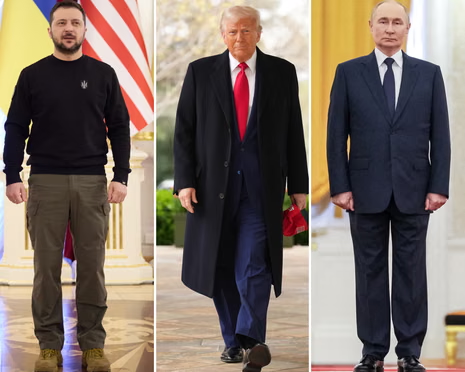
After nearly four years of relentless fighting, fresh diplomatic momentum is building around the Ukraine war. In mid-December 2025, the United States and key European nations have stepped up efforts to push both sides toward a ceasefire, hoping to prevent further escalation as winter deepens across Eastern Europe.
While a full peace agreement remains distant, officials say recent talks mark the most coordinated diplomatic push in months, driven by battlefield fatigue, economic strain, and growing humanitarian concerns.
Why Peace Talks Are Back on the Table
Diplomacy has re-entered the spotlight for several reasons:
-
Frontline stalemate across key regions
-
Rising costs of prolonged military support
-
Energy security fears during winter
-
War fatigue among civilians and soldiers
-
Pressure from European voters for a political solution
Western diplomats believe that even a limited ceasefire could save lives and open space for broader negotiations.
U.S. and European Coordination Intensifies
Senior U.S. envoys have held closed-door meetings with European leaders and Ukrainian officials, focusing on:
-
Temporary ceasefire frameworks
-
Humanitarian corridors
-
Prisoner exchanges
-
Protection of civilian infrastructure
European capitals, particularly Berlin and Paris, are playing a central role in aligning positions and keeping diplomatic channels open.
A Western diplomat described the talks as “pragmatic, not optimistic.”
Ukraine’s Position Remains Firm
President Volodymyr Zelenskyy has welcomed diplomatic engagement but remains cautious.
Ukraine has repeatedly stated that:
-
Any ceasefire must not freeze the conflict permanently
-
Territorial integrity is non-negotiable
-
Security guarantees are essential
Ukrainian officials fear that a poorly structured ceasefire could allow Russia to regroup and resume attacks later.
Russia’s Response: Silence and Signals
Moscow has not publicly committed to the current peace push, but analysts note subtle signals:
-
Reduced intensity in some sectors
-
Increased diplomatic messaging via intermediaries
-
Emphasis on “security guarantees” in official statements
Whether these signals indicate genuine interest or tactical positioning remains unclear.
Humanitarian Pressure Mounts
Winter has intensified the humanitarian toll:
-
Power outages affecting millions
-
Damage to heating infrastructure
-
Displacement of civilians in eastern regions
-
Strain on aid delivery routes
International agencies warn that civilian suffering could worsen sharply without at least a temporary pause in fighting.
Humanitarian considerations are emerging as a key driver behind the ceasefire discussions.
Economic and Political Costs Rising
The prolonged war continues to weigh heavily on:
Europe
-
Higher defence spending
-
Energy price volatility
-
Industrial slowdowns
United States
-
Budget pressure
-
Political debate over long-term military aid
Global Economy
-
Food supply disruptions
-
Shipping and insurance costs
-
Investor uncertainty
These pressures are pushing leaders to reassess whether diplomacy can reduce long-term risks.
What a Ceasefire Could Look Like
Diplomatic sources say discussions are focused on:
-
Localised ceasefires rather than a full truce
-
International monitoring mechanisms
-
Confidence-building steps before formal talks
Experts caution that even a limited pause would be fragile and require strict enforcement.
Analysts Urge Caution
Security experts warn against premature optimism.
“This is not a peace breakthrough — it’s a pressure valve,” said a European security analyst.
“Ceasefires fail when trust is absent, and trust remains extremely low,” another expert noted.
Still, many agree that dialogue is preferable to endless escalation.
Global Implications of a Breakthrough
Even modest progress could:
-
Stabilise energy markets
-
Reduce refugee flows
-
Lower geopolitical risk premiums
-
Create space for reconstruction planning
Conversely, failure could signal a long war stretching well into 2026.
What Happens Next
The coming weeks are crucial.
Possible outcomes include:
-
A limited winter ceasefire
-
Humanitarian pauses around key cities
-
Continued talks without immediate results
Diplomats say the window for progress may close quickly if fighting intensifies again.
Conclusion
As 2025 draws to a close, renewed peace talks on Ukraine reflect growing recognition that the war cannot be solved by force alone. While deep divisions remain, the coordinated push by the U.S. and Europe signals a shift toward diplomacy — even if only incremental.
Whether these efforts lead to lasting calm or fade under battlefield realities will shape not just Ukraine’s future, but global stability in the year ahead.
FAQs
Q1: Are Ukraine and Russia close to a peace deal?
No. Talks are exploratory and focused mainly on ceasefire options.
Q2: Why is winter important for these talks?
Winter increases humanitarian risks and strains military operations.
Q3: Does Ukraine support a ceasefire?
Only if it does not compromise security or territorial integrity.
Q4: Could talks fail again?
Yes. Analysts say progress remains fragile and uncertain.