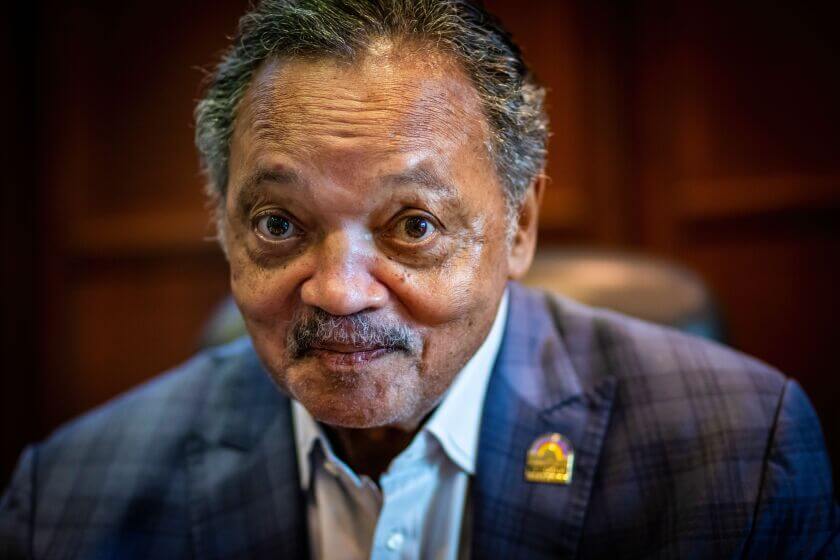
CHICAGO — The Reverend Jesse Louis Jackson Sr., the fiery orator, world-renowned mediator, and two-time presidential candidate who became the preeminent voice for Black America following the assassination of Dr. Martin Luther King Jr., died peacefully on Tuesday morning. He was 84.
His family confirmed the news in a moving statement, noting that the “servant leader” was surrounded by his loved ones at his home in Chicago. Jackson had been battling a series of health complications in recent years, including Parkinson’s disease and Progressive Supranuclear Palsy (PSP), a rare neurological disorder.
“Our father was a servant leader—not only to our family, but to the oppressed, the voiceless, and the overlooked around the world,” the Jackson family said. “He was a man of the people, and today, the people have lost their champion.”
From the Shadow of King to the National Stage
Born on October 8, 1941, in segregated Greenville, South Carolina, Jesse Jackson’s life was an arc that stretched from the Jim Crow South to the highest corridors of global power. He joined the Southern Christian Leadership Conference (SCLC) in the 1960s, quickly becoming a protégé of Dr. Martin Luther King Jr.
Jackson was standing on the balcony of the Lorraine Motel in Memphis on April 4, 1968, when a sniper’s bullet took King’s life. In the traumatic vacuum that followed, it was a 26-year-old Jackson who stepped forward, appearing on national television in a blood-stained turtleneck to urge the nation to continue the work. While his brash style occasionally caused friction with other SCLC veterans, his charisma was undeniable. He understood earlier than most that the civil rights movement needed to evolve from moral persuasion to economic and political power.
“I Am Somebody”: The Empowerment of a Generation
In 1971, Jackson founded Operation PUSH (People United to Save Humanity) in Chicago. His mission was “economic justice,” and his methods were direct. He organized boycotts of major corporations, forcing them to hire Black workers and invest in minority-owned businesses.
Perhaps his most enduring cultural contribution was his rhythmic call-and-response chant: “I am… Somebody!” For millions of Black children living in poverty or under the weight of systemic racism, Jackson’s message was a psychological liberation. He taught a generation that their worth was not defined by their zip code, but by their spirit.
Breaking the Highest Ceiling: The 1984 and 1988 Campaigns
Before there was a Barack Obama, there was Jesse Jackson. In 1984, Jackson launched a long-shot bid for the Democratic presidential nomination. He didn’t just run to make a point; he ran to make a difference. His “Rainbow Coalition” sought to unite the “disinherited”—Black Americans, Latinos, poor whites, LGBTQ+ individuals, and struggling farmers—under a single political banner.
While he did not win the nomination, he won five primaries and caucuses. When he ran again in 1988, he became a frontrunner, winning nearly 7 million votes and 11 primaries. His speech at the 1988 Democratic National Convention remains one of the greatest pieces of American oratory.
“I was born in a slum, but the slum was not born in me,” he famously declared. “And it wasn’t born in you, and you can make it.”
Political analysts credit Jackson’s campaigns with registering millions of new voters and proving that a Black candidate could build a multi-racial coalition, effectively laying the groundwork for the 2008 election of America’s first Black president.
The International Mediator
Beyond domestic politics, Jackson became an “unofficial ambassador” for the United States. He traveled to Syria in 1983 to secure the release of Navy Lt. Robert Goodman, to Iraq in 1990 to negotiate the release of “human shields” held by Saddam Hussein, and to Cuba and Yugoslavia on similar humanitarian missions. His ability to negotiate with dictators and adversaries when formal diplomacy failed earned him the Presidential Medal of Freedom in 2000.
A Legacy of Controversy and Resilience
Jackson was never a figure of quiet consensus. He was often criticized for being a “grandstander” who sought the spotlight. In 1984, he faced significant backlash for using an anti-Semitic slur in a private conversation—a comment he later apologized for and worked for decades to atone for by building bridges with Jewish communities.
Even in his later years, as Parkinson’s disease began to rob him of his physical strength and his ability to speak clearly, Jackson remained on the front lines. He was seen in a wheelchair at Black Lives Matter protests in 2020 and 2021, and he stood with the family of George Floyd during the trial of Derek Chauvin.
Tributes from a Grateful Nation
As news of his passing broke, leaders from across the political spectrum offered their condolences. President Joe Biden hailed him as a “moral compass for the nation,” while Rev. Al Sharpton described his mentor as “a giant whose shoulders we all stand upon.”
“He kept the dream alive,” Sharpton said. “He taught us that even if we had broken spirits, we didn’t have to stay broken. He showed us that we belong in the rooms where decisions are made.”
Conclusion: “Keep Hope Alive”
Jesse Jackson’s final months were quiet, a stark contrast to a life lived at full volume. He reportedly spent his time listening to the gospel music he loved and squeezing the hands of visitors when he could no longer find the words to speak.
With his death, the last of the “Old Guard” of the King era has departed. He leaves behind his wife of over 60 years, Jacqueline Lavinia Brown, and five children, including Congressman Jonathan Jackson and former Congressman Jesse Jackson Jr.
His legacy is not just in the laws he helped influence or the prisoners he freed, but in the millions of people who looked at him and finally believed they were “somebody.” As he would often close his speeches: “Keep hope alive.”