
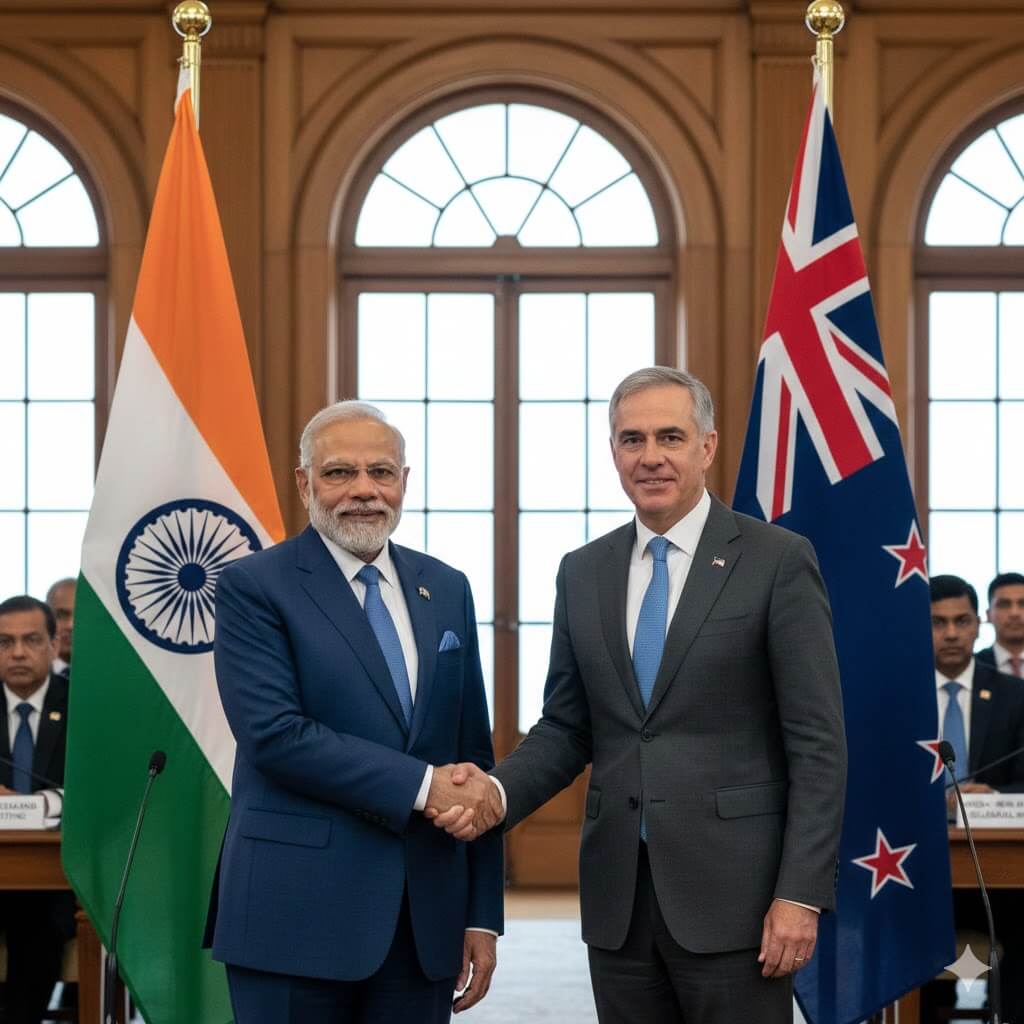
NEW DELHI/AUCKLAND — In a major boost to “Viksit Bharat 2047,” India and New Zealand have officially concluded negotiations for a historic Free Trade Agreement (FTA). The deal, finalized on December 22, 2025, provides unprecedented market access, with New Zealand offering zero-duty entry for 100% of Indian goods—a first for any of India’s major trade partners.
The agreement was announced following a high-level exchange between PM Narendra Modi and his New Zealand counterpart, Christopher Luxon. Launched only in March 2025, the pact was wrapped up in just nine months, reflecting a shared political will to bypass a decade of stalled talks.
100% Zero-Duty: A Game-Changer for Indian MSMEs
Under the terms of the FTA, New Zealand will eliminate tariffs on all 8,284 tariff lines for Indian products from day one. This move is expected to supercharge India’s labor-intensive sectors, including:
-
Textiles and Apparel
-
Leather and Footwear
-
Gems and Jewellery
-
Engineering Goods and Pharmaceuticals
For Indian MSMEs, this means a significant reduction in landed costs in the Pacific market, making Indian craftsmanship more competitive than ever.
The “Services and Mobility” Pillar
Beyond goods, the FTA opens massive doors for the Indian workforce. For the first time, New Zealand has signed a dedicated Annex on Student Mobility and Post-Study Work Visas with another country.
-
STEM Graduates: Indian students completing Bachelor’s or Master’s in Science, Technology, Engineering, or Math can now stay and work for up to three years.
-
Doctoral Scholars: Post-study work visas have been extended to four years.
-
Temporary Employment Visa: A new pathway for 5,000 Indian professionals at any given time to work in New Zealand for up to three years. This covers IT, healthcare, and even niche roles like Yoga instructors and Indian chefs.
$20 Billion Investment Commitment
New Zealand has committed to facilitating $20 billion in Foreign Direct Investment (FDI) into India over the next 15 years. These funds are targeted at infrastructure, manufacturing, and innovation, directly supporting the “Make in India” initiative.
Safeguarding Indian Farmers: The “Red Lines”
India has maintained a calibrated approach to protect its sensitive sectors. Concessions on Dairy (milk, cheese, yogurt), onions, sugar, and edible oils have been strictly excluded to safeguard domestic farmers. However, New Zealand has gained limited access for premium products like Kiwifruit and Manuka Honey through a Tariff Rate Quota (TRQ) system, ensuring that imports do not disrupt local prices.
Quick Highlights: India–New Zealand FTA 2025
| Feature | Impact |
| Indian Exports | 100% Zero-Duty Access to New Zealand |
| Investment | $20 Billion into India over 15 years |
| Professional Visas | 5,000 per year (IT, Health, AYUSH) |
| Student Mobility | Up to 4-year post-study work visas |
| Bilateral Trade Goal | $5 Billion by 2030 |
View the full framework on the Ministry of Commerce & Industry Portal.
Expert Analysis: A Strategic Reset in the Indo-Pacific
By the Breaking News Today World Desk
This FTA is less about the current trade volume ($2.1 billion) and more about a strategic reset. By securing 100% duty-free access, India has turned New Zealand into a gateway for the wider Oceania market. Furthermore, the inclusion of an Annex on Health and Traditional Medicine (AYUSH) is a massive win for India’s soft power, marking the first time a developed nation has formally recognized India’s traditional medicine systems within a trade pact.
As the world trends toward protectionism, the India–New Zealand deal stands as a beacon of open, rules-based trade that prioritizes people-to-people ties as much as profit margins.