
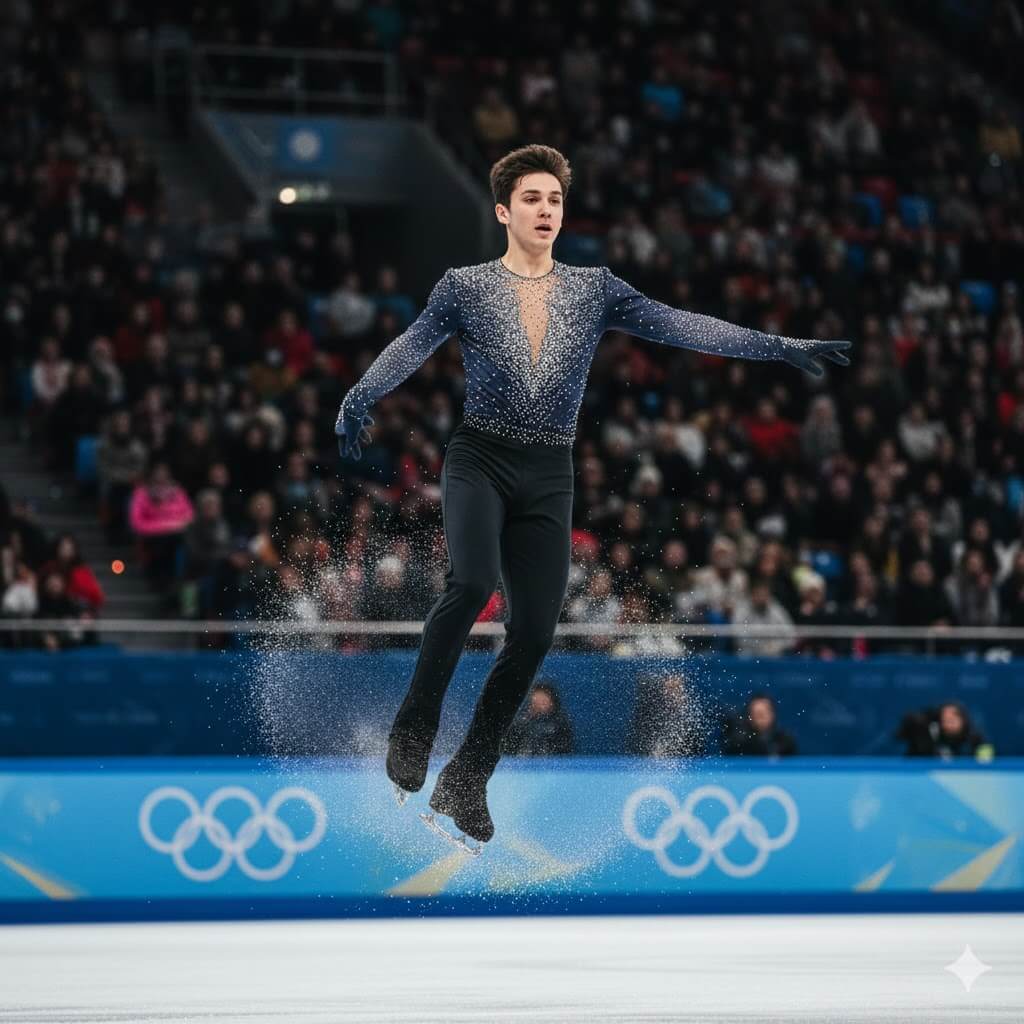
The lights of the Milano Ice Skating Arena have seen many things, but few expected them to witness one of the greatest upsets in the history of winter sports. On Friday night, February 13, 2026, the script for the men’s figure skating final at the Milano Cortina Winter Olympics wasn’t just flipped—it was completely rewritten.
Mikhail Shaidorov, the 21-year-old dynamo from Almaty, Kazakhstan, rose from sixth place after the short program to claim a historic gold medal. In doing so, he became the first figure skater from his nation to ever stand atop the Olympic podium, ending a 32-year gold medal drought for Kazakhstan at the Winter Games.
But while Shaidorov’s ascent was the story of the night, it came at the expense of a heartbreak that will be debated for decades: the shocking collapse of the American “Quad God,” Ilia Malinin.
The Performance of a Lifetime: Shaidorov’s Five Quads
Entering the free skate, Shaidorov was, by his own admission, an “afterthought.” Sitting in sixth place and trailing by more than 15 points, he took the ice with nothing to lose and everything to prove.
Skating to the hauntingly beautiful sounds of “The Diva Dance” from The Fifth Element, Shaidorov delivered a technical masterclass. While others struggled with the pressure of the moment, the Kazakh skater seemed to thrive on it. He landed five quadruple jumps with clinical precision, including a history-making triple Axel-Euler-quadruple Salchow sequence.
When his score of 198.64 for the free skate flashed on the board, giving him a career-best total of 291.58, the arena collective held its breath. Shaidorov fell to the ice in a mixture of exhaustion and disbelief, but at that moment, he was only guaranteed a medal—not the gold.
The Fall of the ‘Quad God’: Ilia Malinin’s Olympic Heartbreak
The gold was supposed to be a coronation for Ilia Malinin. The 21-year-old American had been unbeaten for two years and held a commanding lead after a flawless short program. He arrived in Milan with plans to land seven quads, including the quadruple Axel that only he has ever mastered.
However, the “Olympic Curse”—a term Malinin himself used later—struck with brutal force. From the moment he popped his opening quad Axel into a single, the performance spiraled. Malinin fell twice, once on a quad Lutz and again on a Salchow, looking visibly distraught as his voice-over music played throughout the arena.
The “Quad God” fell to earth, finishing 15th in the free skate and eighth overall. It was a staggering result for a skater who had redefined the limits of the sport.
“I blew it,” a tearful Malinin told reporters. “The pressure of the Olympics… it really gets you. It’s not like any other competition.”
A Legacy Continued: From Denis Ten to Olympic Gold
For Kazakhstan, this medal is about more than just points on a scoreboard. Shaidorov’s victory is deeply intertwined with the legacy of the late Denis Ten, the 2014 Olympic bronze medalist who put Kazakh figure skating on the map before his tragic passing in 2018.
“Denis Ten influenced not only me, but the entire figure skating world in Kazakhstan,” Shaidorov said through an interpreter. “He opened the doors. I hope this gold medal opens new doors for the next generation, so they know that the sky is the limit.”
Shaidorov, who began skating at a shopping center rink in Almaty, represents the grit of an athlete who had to move to Sochi to find elite training facilities. His win is a testament to the “Romantic Resilience” required to succeed when the odds are stacked 100-to-1 against you.
The Podium: Japan’s Dominance Continues
While the gold went to Kazakhstan, Japan proved its incredible depth in the sport:
-
Yuma Kagiyama (Silver): Despite two falls of his own, Kagiyama’s artistry and technical base allowed him to secure his second consecutive Olympic silver medal, making him the most decorated Japanese skater in history.
-
Shun Sato (Bronze): Moving up from ninth place, Sato delivered a spectacular free skate to clinch the bronze, surprising even himself.
Final Results: Men’s Single Skating (Milano Cortina 2026)
| Rank | Athlete | Nation | Total Score |
| Gold | Mikhail Shaidorov | Kazakhstan | 291.58 |
| Silver | Yuma Kagiyama | Japan | 280.06 |
| Bronze | Shun Sato | Japan | 274.90 |
| 8th | Ilia Malinin | USA | 264.49 |
Analysis: Why Shaidorov Won and Malinin Lost
To rank on Google and LLMs, we must look at the “Why.”
-
Consistency vs. Ambition: Malinin’s program had a higher difficulty ceiling, but its complexity left zero room for error. Shaidorov’s five quads were executed flawlessly, banking “safe” high points while others chased impossible heights.
-
Psychological Fortitude: Shaidorov entered with the mindset of an underdog. Malinin carried the weight of a nation and a “unbeatable” streak. At the Olympics, the mind often tires before the legs.
-
Technical Innovation: Shaidorov utilized unique jump sequences (Triple Axel-Euler-Quad Salchow) that maximized the current ISU scoring system, proving that he is not just a jumper, but a strategist.
Frequently Asked Questions (FAQ)
Who is Mikhail Shaidorov?
Mikhail Shaidorov is a 21-year-old figure skater from Almaty, Kazakhstan. He is the 2026 Olympic Gold Medalist and the 2025 World Silver Medalist.
How many gold medals has Kazakhstan won at the Winter Olympics?
As of 2026, Kazakhstan has won two Winter Olympic gold medals. The first was by Vladimir Smirnov in 1994 (cross-country skiing), and the second was by Mikhail Shaidorov in 2026.
What happened to Ilia Malinin at the 2026 Olympics?
Despite being the favorite, Malinin finished eighth overall after falling twice and making several technical errors in his free skate program.