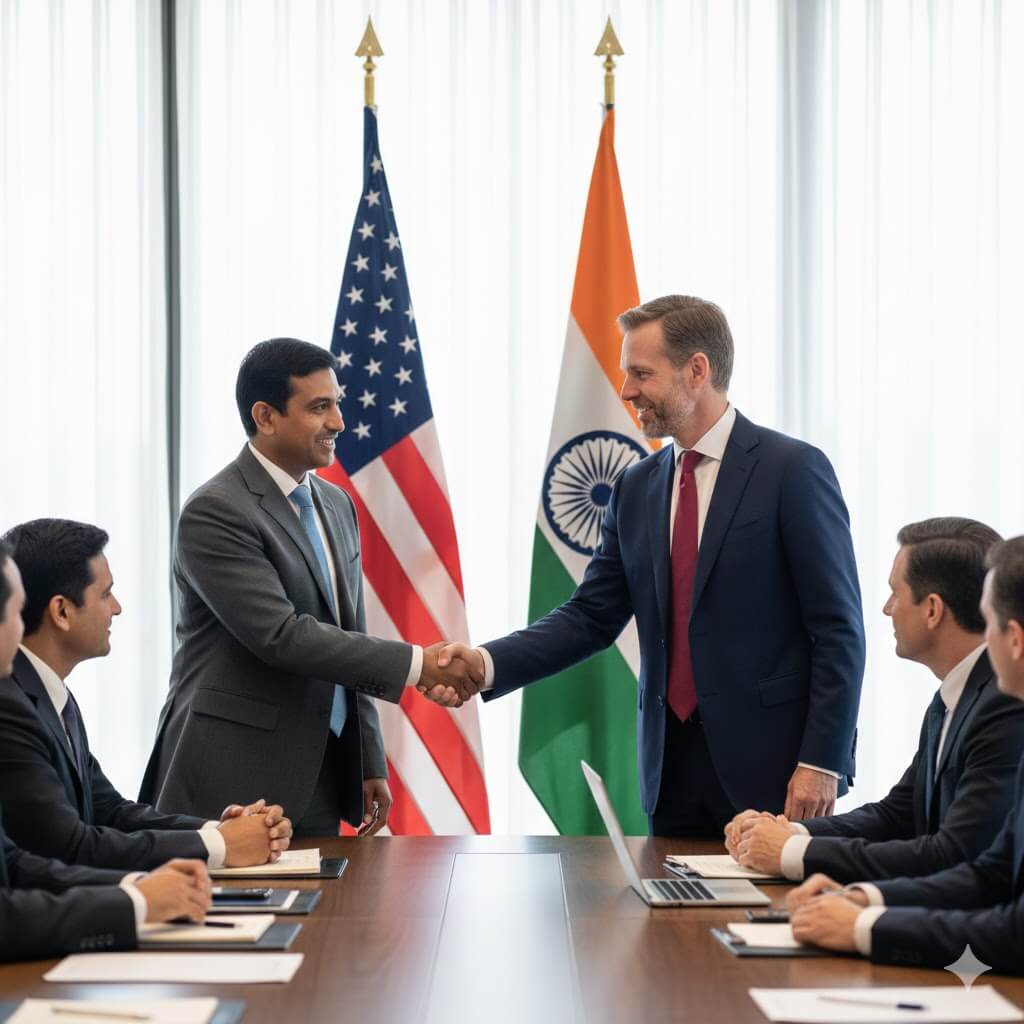
Washington / New Delhi | February 14, 2026: Former U.S. President Donald Trump on Thursday praised a renewed India-US trade framework, calling it a “major step forward” for jobs investment and long-term strategic ties between the world’s largest and fifth-largest economies. The Trump India trade announcement comes at a time when both nations are recalibrating supply chains, boosting manufacturing, and deepening defense cooperation amid global geopolitical shifts.
The bilateral agreement, according to officials familiar with the discussions, aims to expand market access, reduce tariff barriers in selected sectors, and unlock fresh investment commitments across manufacturing, technology, and energy.
Key Highlights
- Trump India trade initiative emphasizes jobs investment and supply chain diversification.
- Bilateral agreement focuses on manufacturing, defense, semiconductors, and clean energy.
- Export boost expected for pharmaceuticals, electronics, and agricultural products.
- Move aligns with India’s Viksit Bharat 2047 development vision.
- Strategic ties strengthened amid Indo-Pacific geopolitical shifts.
What Happened: Details of the Bilateral Agreement
During remarks delivered in the United States on February 13, 2026, Trump described the India-US trade deal as “fair, reciprocal, and job-creating.” While full documentation is yet to be publicly released, officials indicated the framework includes:
- Expanded tariff relief on selected U.S. agricultural and industrial goods.
- Enhanced market access for Indian pharmaceutical and IT services firms.
- New investment corridors targeting semiconductor manufacturing.
- Defense procurement cooperation and co-production agreements.
Trade between India and the United States crossed approximately $190 billion in goods and services in recent years, making the U.S. India’s largest trading partner. The renewed push is expected to accelerate that trajectory.
Trump India Trade: Strategic and Economic Context
Supply Chain Realignment
Global supply chains have undergone restructuring since 2020 due to geopolitical tensions and pandemic disruptions. The new bilateral agreement positions India as an alternative manufacturing hub, complementing U.S. efforts to reduce dependency on single-country sourcing models.
Alignment with Viksit Bharat Vision
India’s long-term Viksit Bharat roadmap seeks to transform the country into a developed economy by 2047. Increased U.S. investment in electronics, renewable energy, and high-value manufacturing supports that ambition.
Defense and Indo-Pacific Cooperation
Strategic ties between New Delhi and Washington have deepened through Quad engagement and Indo-Pacific security coordination. Trade and defense cooperation are increasingly interlinked.
Why It Matters for India and the United States
The Trump India trade narrative is not limited to tariff reductions. It signals broader economic diplomacy.
- For India: Export boost, capital inflows, technology transfer, and job creation.
- For the United States: Market access, strategic balancing in Asia, and domestic manufacturing incentives.
- For global markets: Reduced trade friction between two major economies could stabilize investor sentiment.
Economists suggest that even a 5–8% expansion in bilateral trade volumes could translate into billions in additional GDP impact across both economies.
Expert Insight and Market Reaction
Policy analysts in Washington describe the agreement as “strategic economics” — where trade is used as a geopolitical instrument.
Indian market observers note that sectors likely to benefit include:
- Information Technology services
- Pharmaceutical exports
- Defense manufacturing
- Renewable energy infrastructure
Equity markets in India responded cautiously, with export-oriented stocks witnessing moderate gains in early trade.
What Most News Sites Are Missing
Much of the current coverage highlights headline optics — Trump praising India and references to job creation. What is underreported is the potential impact on currency stability and capital flows.
Increased U.S. investment commitments could strengthen India’s foreign exchange reserves and moderate volatility in the rupee. Additionally, deeper semiconductor cooperation may shift long-term technological dependence patterns in Asia.
This is not merely a trade adjustment; it is structural economic positioning for the next decade.
What Happens Next?
- Formal publication of agreement text.
- Legislative or regulatory approvals in both countries.
- Business delegation visits to operationalize sectoral commitments.
- Implementation timeline announcements within the next quarter.
Markets and diplomatic observers will watch execution rather than rhetoric in the coming months.
Frequently Asked Questions (FAQs)
What is the Trump India trade deal about?
It is a renewed bilateral agreement aimed at boosting jobs investment, expanding exports, and strengthening strategic ties between India and the United States.
How much is India-US trade currently worth?
Bilateral trade in goods and services has crossed approximately $190 billion in recent years.
Which sectors benefit the most?
Pharmaceuticals, IT services, semiconductors, defense manufacturing, and renewable energy sectors are expected to gain.
Does this support Viksit Bharat?
Yes. Increased foreign investment and technology collaboration align with India’s long-term development vision.
When will the agreement take effect?
Implementation timelines will depend on formal approvals and sector-level policy notifications.