
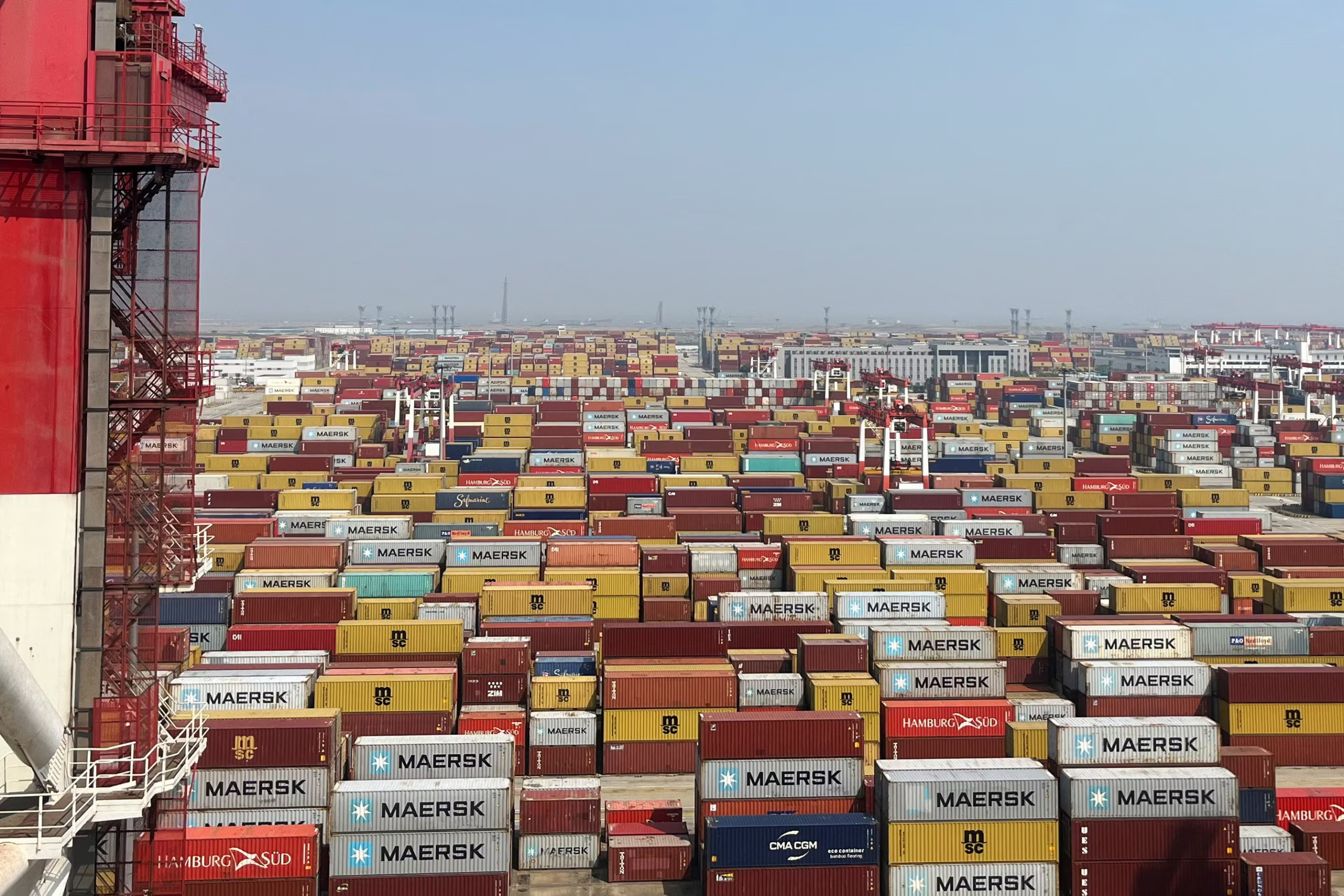
In a surprising development that defies economic expectations, China’s exports continued to surge strongly in November 2025, even as the yuan strengthened against major global currencies. Typically, a stronger yuan makes Chinese goods more expensive for overseas buyers — but rising global demand appears to have more than offset any pricing disadvantages.
The latest data reinforces China’s status as the world’s largest export powerhouse, even amid slowing global consumption, geopolitical tensions, and a shifting currency landscape.
China’s Export Engine Still Running Hot
Despite global manufacturing weakness, China’s export numbers remained robust thanks to strong demand in:
-
Electronics & semiconductors
-
Renewables & clean-energy technology
-
EVs and automotive components
-
Medical devices
-
Apparel & consumer goods
-
Industrial machinery
🔥 Top-performing sectors:
-
Electric Vehicles (EVs): China continues to dominate global EV exports.
-
Solar technology: Panels and batteries saw double-digit export growth.
-
Electronics: Despite chip shortages easing, Chinese firms held strong market share.
This export momentum has surprised analysts who expected the rising yuan to cool demand.
Why the Strong Yuan Didn’t Slow China’s Exports
The yuan has appreciated steadily through late 2025 due to:
-
Strong foreign capital inflows
-
Higher interest rates relative to Western economies
-
Stabilizing domestic markets
-
Confidence in China’s long-term growth
Normally, a stronger yuan raises export prices — but several factors kept Chinese exports competitive:
1️⃣ China’s Scale Advantage
Massive economies of scale allow Chinese manufacturers to keep prices stable, even with currency appreciation.
2️⃣ Shift in Global Supply Chains Toward Reliability
After global supply shocks in 2023–2024, many buyers prefer stable, proven suppliers, even if costs rise slightly.
3️⃣ High Global Demand for Green Tech
China leads global production of:
-
Solar panels
-
EV batteries
-
Wind components
-
Lithium processing
Demand remains strong, regardless of currency movements.
4️⃣ Increased Domestic Subsidies & Support
Government incentives for key industries — especially EVs and semiconductors — help offset currency-driven cost increases.
Impact on the Global Economy
China’s strong exports have several implications:
🌐 1. Reinforcing China’s Supply Chain Dominance
Despite global efforts to diversify supply chains, China continues to be the world’s manufacturing backbone.
🏭 2. Pressure on Competing Exporters
Countries like:
-
Vietnam
-
Indonesia
-
India
-
Mexico
…may struggle to match China’s scale and pricing advantages, especially in electronics and EVs.
💸 3. Impact on Global Inflation
Cheaper Chinese goods can help moderate inflation in importing countries — particularly the U.S. and Europe.
🔁 4. Trade Tensions May Rise Again
With the U.S. election cycle approaching, China’s export surge could reignite debates around:
-
Tariffs
-
Currency manipulation
-
Anti-dumping investigations
Challenges Still Remain for China
Despite strong exports, China faces structural hurdles:
-
Weak domestic consumption
-
Real estate market instability
-
Youth unemployment
-
Slowing manufacturing investment
-
Global protectionism
Export strength may not fully offset internal economic pressures in 2026.
Analyst Commentary
Experts say China’s export performance reflects deep competitive advantages.
“Even with a stronger yuan, China’s manufacturing machine is unmatched. Scale, supply chain depth, and technological maturity keep exports strong,” said a Shanghai-based economist.
Another analyst noted:
“This data shows that global dependence on Chinese supply chains remains high. Diversification is happening, but slowly.”
Outlook for the Coming Months
Exports
Expected to remain strong through early 2026, especially for EVs, batteries, and electronics.
Yuan
May face upward pressure unless global markets shift sharply.
Trade Policy
U.S. and EU could introduce new trade measures in response to China’s growing export surplus.
Conclusion
China’s export boom in November 2025, despite a rising yuan, highlights the country’s sustained manufacturing competitiveness and global supply-chain dominance. As industries like EVs, renewable tech, and electronics flourish, China remains positioned as the world’s production hub — even amid currency fluctuations and global economic uncertainty.
As 2026 approaches, China’s export strength will continue shaping global trade dynamics and geopolitical debates.
FAQs
Q1: Why didn’t the strong yuan hurt China’s exports?
Because China’s manufacturing scale, subsidies, and strong global demand kept exports competitive.
Q2: Which sectors drove export growth?
EVs, solar tech, electronics, and industrial machinery.
Q3: Will China’s export boom continue?
Analysts expect strong performance through early 2026.
Q4: Why is global dependence on China still high?
Due to robust supply chains, lower costs, and unmatched production capacity.