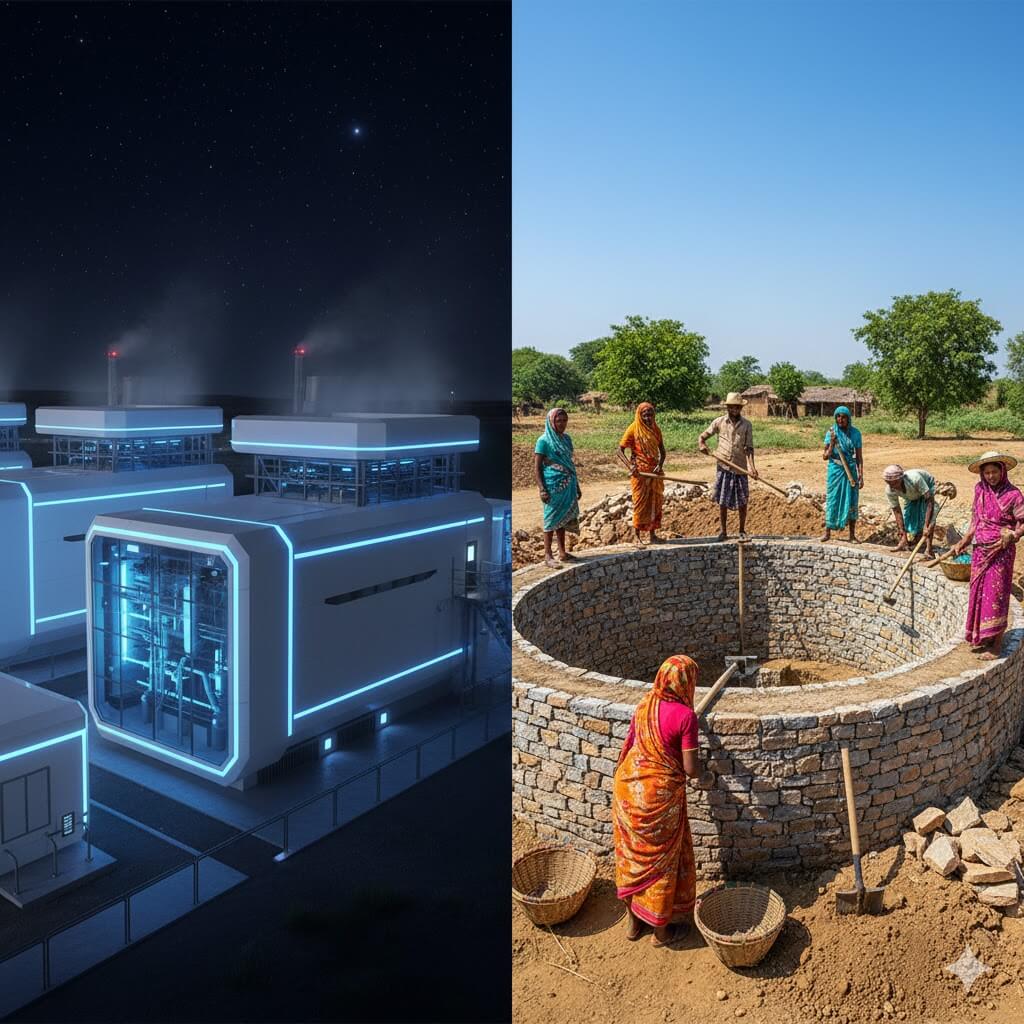
NEW DELHI — In a weekend that will likely be remembered as a turning point for modern India, President Droupadi Murmu has officially granted her assent to two of the most consequential pieces of legislation in recent history: the SHANTI Act and the VB-G RAM G Act.3
By signing these Bills into law, the President has effectively ended a 60-year government monopoly on nuclear energy and retired the two-decade-old MGNREGA scheme.4 These moves are the clearest signals yet of the government’s intent to pivot toward a more decentralized, private-sector-led “Viksit Bharat” by 2047.5
The SHANTI Act: Powering the Private Nuclear Dream
The Sustainable Harnessing and Advancement of Nuclear Energy for Transforming India (SHANTI) Act, 2025, is a total reset for India’s energy policy.6
For the first time since Independence, private Indian companies and joint ventures are now legally permitted to build, own, and operate nuclear power plants.7 By repealing the Atomic Energy Act of 1962, the SHANTI Act removes the “NPCIL-only” bottleneck that has kept nuclear power at a mere 3% of India’s energy mix for decades.8
Key Guardrails:
-
Sovereign Control: While private players can generate power, the government retains exclusive control over uranium mining, fuel enrichment, and waste management.9
-
Statutory Regulator: The Atomic Energy Regulatory Board (AERB) has finally been granted statutory status, giving it more independence to enforce safety standards.10
The VB-G RAM G Act: Rural Jobs 2.0
Just hours before signing the energy bill, the President cleared the Viksit Bharat—Guarantee for Rozgar and Ajeevika Mission (Gramin) Act.11 This officially replaces MGNREGA, increasing the statutory employment guarantee from 100 to 125 days per household.12
The new law moves away from “adhoc work” and toward the creation of productive assets like climate-resilient roads and water conservation systems.13 It also introduces a “60-day agricultural pause” to ensure that village labor remains available during peak farming seasons—a move that has been welcomed by farmers but closely watched by labor advocates.14
A Weekend of Political Fireworks
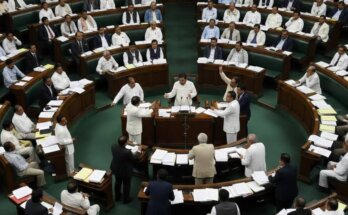
The President’s signature comes after a stormy Winter Session of Parliament where the Opposition staged multiple walkouts, particularly over the “corporatization” of rural jobs. However, the government has stood firm, arguing that these reforms are necessary to modernize governance and improve fiscal discipline through a new 60:40 funding split between the Centre and the States.15
Quick Summary: The Two New Pillars of 2025
| Law | Old Act Replaced | Major Change |
| SHANTI Act | Atomic Energy Act, 1962 | Private sector can now build/operate nuclear plants. |
| VB-G RAM G Act | MGNREGA, 2005 | Work guarantee raised to 125 days; 60:40 funding split. |
Expert Analysis: Why These Laws are “Twins”
By the Breaking News Today Politics Desk
Although they deal with very different sectors, the SHANTI and VB-G RAM G Acts share a single DNA: Modernization through Structured Accountability. The SHANTI Act brings in the capital and technology that the public sector alone cannot provide to hit India’s 100 GW nuclear target.16 Simultaneously, the VB-G RAM G Act seeks to turn rural labor into a “National Infrastructure Stack.”17 Together, they represent a high-stakes bet that India can achieve developed-nation status by empowering private enterprise and decentralizing rural growth.