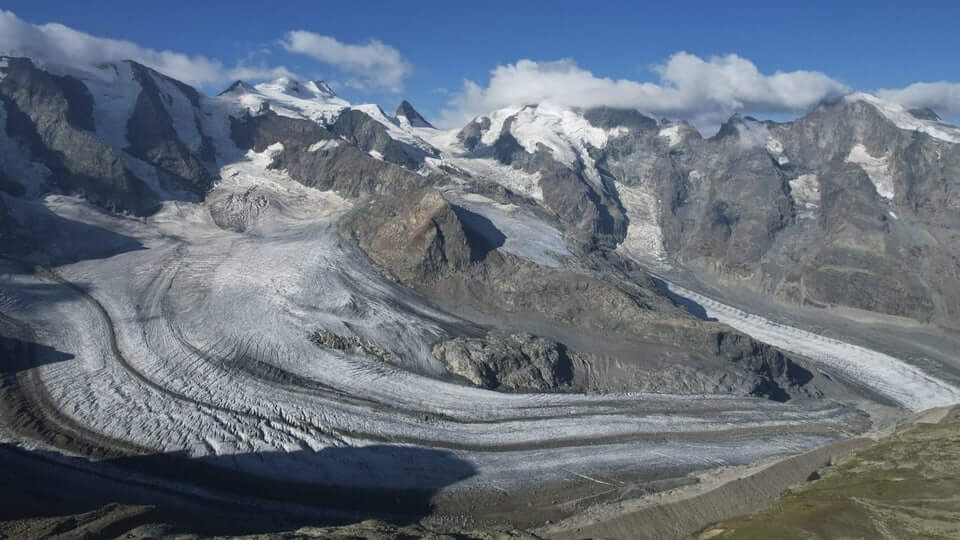
Europe’s iconic Alpine glaciers are disappearing far faster than previously predicted, according to new scientific assessments released in mid-December 2025. Researchers monitoring ice mass across the Alps warn that large sections of permanent ice may vanish within the next few decades, threatening water supplies, tourism, and fragile mountain ecosystems.
The findings have reignited concern across Europe, as warming temperatures continue to reshape landscapes that have remained frozen for thousands of years.
What the Latest Research Shows
Glaciologists studying the Alps — which stretch across France, Switzerland, Italy, Austria, and Germany — report:
-
Record ice loss during recent summers
-
Thinner glacier layers and retreating ice fronts
-
Reduced snowfall failing to replenish melting ice
Several glaciers have already lost more than half their volume since the early 2000s, with 2025 marking another year of accelerated decline.
Scientists say even colder winters are no longer enough to offset the intense summer melt.
Why Alpine Glaciers Matter
Though small compared to polar ice sheets, Alpine glaciers play a critical role in Europe:
-
Supplying freshwater to rivers such as the Rhine, Rhône, and Po
-
Supporting hydroelectric power generation
-
Regulating mountain ecosystems
-
Sustaining tourism and winter sports economies
Their loss could disrupt water availability during dry summers, particularly in southern Europe.
Climate Change Driving the Melt
Experts point to rising average temperatures as the primary cause.
Key factors include:
-
Warmer summers lasting longer
-
Fewer snow days at lower altitudes
-
Increased rainfall instead of snowfall
-
Heatwaves reaching high mountain regions
The Alps are warming faster than the global average, making them especially vulnerable to climate shifts.
Impact on Communities and Tourism
Mountain communities are already feeling the effects.
Tourism challenges:
-
Shorter ski seasons
-
Increased costs for artificial snow
-
Safety risks from unstable ice and rockfalls
Some resorts have begun shifting toward year-round tourism models, while others face economic uncertainty as winter conditions become less reliable.
Rising Natural Hazards
Melting glaciers increase the risk of:
-
Landslides
-
Avalanches
-
Glacial lake outburst floods
-
Rock collapses previously held together by ice
Authorities across Alpine regions have stepped up monitoring and early-warning systems to protect residents and infrastructure.
Scientific Warning: A Point of No Return
Researchers caution that once glaciers shrink beyond a certain size, recovery becomes impossible, even if temperatures stabilise.
“Many Alpine glaciers are approaching irreversible thresholds,” one European climate scientist said.
“What we lose in the next 10 to 20 years may never return.”
Projections suggest that without sharp emission cuts, up to 90% of Alpine glaciers could disappear by the end of the century.
Policy and Climate Action Pressure
The findings have added pressure on European governments to:
-
Accelerate emissions reduction targets
-
Invest in climate adaptation for mountain regions
-
Improve water-management planning
-
Support affected communities and industries
Environmental groups say glacier loss is one of the clearest, most visible signs of climate change unfolding in real time.
Public Awareness and Symbolic Loss
In recent years, Alpine communities have held symbolic events, including:
-
Glacier “funerals”
-
Public art installations
-
Educational campaigns
These efforts aim to raise awareness about climate change by highlighting the emotional and cultural loss tied to vanishing glaciers.
What Happens Next
Scientists plan to:
-
Expand glacier monitoring using satellites and drones
-
Improve predictive climate models
-
Share data with policymakers and water authorities
While adaptation measures may reduce some impacts, experts stress that mitigation remains essential to slow long-term ice loss.
Conclusion
The rapid retreat of Europe’s Alpine glaciers is no longer a distant warning — it is a present-day reality. As ice that shaped Europe’s mountains for millennia disappears, scientists are urging urgent action to limit further damage.
Without decisive global efforts to curb warming, the Alps may soon lose one of their most defining features, reshaping landscapes, livelihoods, and ecosystems across the continent.
FAQs
Q1: Why are Alpine glaciers melting so fast?
Rising temperatures, reduced snowfall, and longer summers driven by climate change.
Q2: Which countries are affected?
France, Switzerland, Italy, Austria, and Germany.
Q3: Can glaciers recover if temperatures fall?
Many cannot — once they shrink past a certain point, recovery is unlikely.
Q4: How does this affect people?
It impacts water supply, tourism, energy production, and increases natural hazards.